A Part 11–compliant eClinical platform, built from zero and running real trials
How Vial replaced six-figure vendor EDC and RTSM contracts with five in-house applications, built by a small team, inspection-ready from the first release.
Queries · this protocol
RTSM · kit assignment
Part 11
Build, not buy — but only what had to be ours. We built the EDC, RTSM and portals, and composed e-signature, forms and identity from existing tools rather than re-inventing them under Part 11. Fewer new concepts, more shipped.
— The call I madeChallenge:
Vial runs its own Phase 1 trials. Running them on vendor EDC and RTSM meant six figures per study, slow change requests, and a casebook that never quite matched how a coordinator actually works a visit. Every protocol amendment became a vendor ticket; every new form, a negotiation.
The alternative was to build — but a clinical data system is not a normal product. It has to be inspection-ready from the first day a real subject's data lands in it, and the team building it also had trials to run.
- Cost and speed: Vendor contracts scaled per trial, and a change that took us a day took a vendor weeks.
- Part 11 from day one: Audit trails, controlled e-signatures and PHI handling could not be bolted on later — the first release had to pass an inspection.
- Blinding and roles: Monitors, CRAs, data managers, investigators and blinded staff all needed different views of the same casebook, with no path for a blind to leak.
- A small team: The same people building the platform were supporting live sites. Every new concept in the product was a concept someone had to validate and document.
Solution:
We built the pieces that had to be ours — the EDC, the RTSM, and the three portals — and composed everything else from tools that already carried their own compliance story. The design rule throughout: use existing platform behaviour before inventing a new concept, so that data and forms never diverge between studies.
- Form engine with reserved-token conventions so eCRFs stay consistent across studies and protocol versions — one simpler model instead of per-study exceptions
- Audit log with append-not-mutate PHI redaction — compliant without rewriting history
- Native investigator sign-off: controlled signing reasons, re-sign rules tied to data changes and locks, delegation enforced through the Admin app
- The patient-facing surfaces that keep people enrolled: Part 11 eConsent (signature manifest, FDA 11.100(c) letter), re-consent flagging per protocol version, participant payment milestones
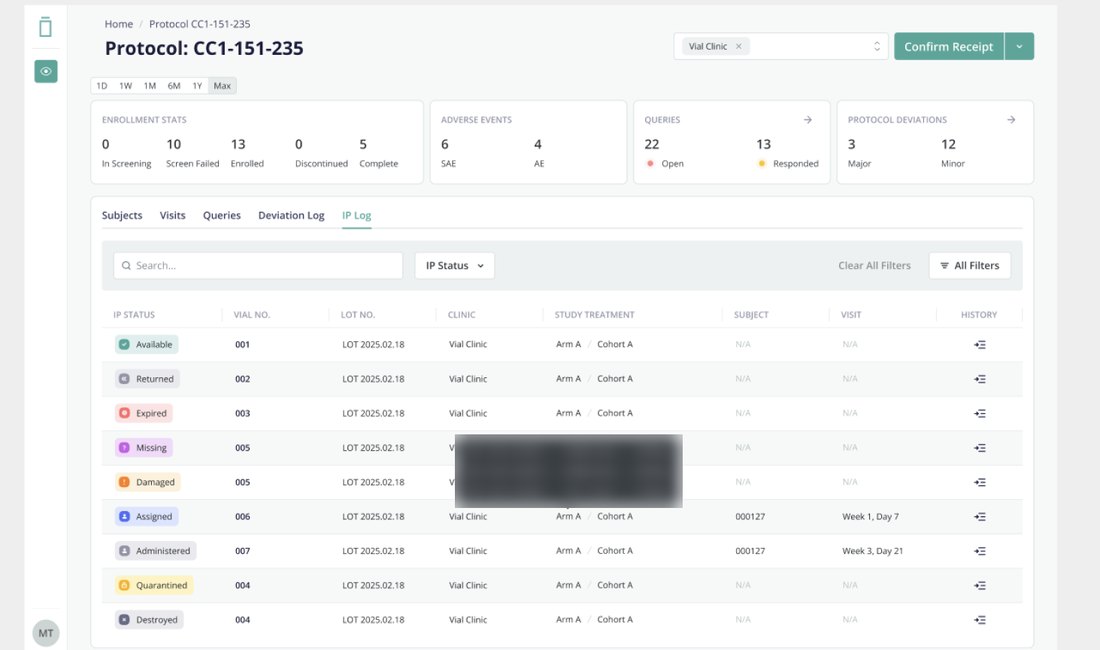
- RTSM v3 — cohort assignment, kit assignment, IP administration and IP log
- Source upload with de-identification and PI assessment, so a site spends minutes, not an afternoon, per visit
How it grew
From a blank repository to five applications, in the order a trial actually needs them.
Impact:
Every Vial Phase 1 trial runs on the platform: sites enter data, monitors review it, investigators sign it, and the RTSM assigns kits — with no vendor in the loop. The build-vs-buy analysis that justified it held up in practice: roughly 4.7× lower cost than vendors at five trials amortised over two years.
Just as important is what it changed for the people in it. A protocol amendment is a form change we ship in a release, not a vendor ticket. A coordinator uploads source and moves on. An investigator signs with a controlled reason and the audit log tells the whole story.
A build-vs-buy memo plus clickable prototypes took leadership from “why” to “when” in a single review. From there, it was daily work with engineering and design — tickets specified tightly enough that a coding agent implements and one engineer approves.
— How it came together